

Quick Answer
To convert watts to amps, divide power by voltage: Amps = Watts ÷ Volts. Example: 100W ÷ 120V = 0.83A. On a 240V circuit, the same 100W device draws 100 ÷ 240 = 0.42A. For AC loads with a power factor below 1.0, use Amps = Watts ÷ (Volts × Power Factor).
Key Takeaways
- Watts (W) measure power — the rate energy is used or produced. Amps (A) measure current — the rate electric charge flows. Volts (V) measure the electrical "pressure" pushing that charge.
- The core formula is Watts = Amps × Volts (P = I × V), rearranged as Amps = Watts ÷ Volts to convert the other way.
- AC (alternating current) calculations require a power factor; DC (direct current) calculations do not, since DC has no phase difference between voltage and current.
- For real-world wiring, the NEC's 80% continuous-load rule means a circuit's safe sustained amperage is 80% of its breaker rating, which matters when converting a device's wattage to the breaker size it needs.
- Battery-powered systems (e-bikes, e-motorcycles, battery swap cabinets) typically run on 12V, 24V, 48V, or 72V — knowing the amps at each voltage is essential for sizing wiring, fuses, and chargers correctly.
- 1 amp-hour (Ah) means 1 amp of current sustained for 1 hour; it's how battery capacity — from AA cells to EV and solar batteries — is rated.
Electricity powers our modern world, lithium battery 12v 100ah is everywhere in our lives, but understanding the terminology that accompanies it can be a bit like deciphering a foreign language for many people. Terms like watts, amps, volts, AC, DC, ohms, and amp-hours are thrown around, often leaving us bewildered. In this article, we'll shed light on these electrical concepts, explore watts to amps and how they relate to each other, and provide practical tips for conversions and calculations.

Main content:
- Key Takeaways
- Introduction
- How to Convert Watts to Amps (Step-by-Step)
- How to Convert Amps to Watts
- Quick Watts to Amps Calculator (add calculator)
-
Watts to Amps Conversion Charts
- 120V (Standard US Household Circuit)
- 240V (High-Power Appliances, EU/UK Household Standard)
- 12V (Common for E-bike/Scooter Electronics, Small Batteries, Solar Panels)
- 24V (Common for E-bikes, Golf Carts, Small Solar/Battery Systems)
- 48V (Common for E-bikes, E-motorcycles, Home Battery Storage)
- 72V (Common for Electric Motorcycles and Higher-Power EVs)
- Real-Life Watts to Amps Examples
- Why AC Power Calculations Need a Power Factor
- Watts to Amps in Real Wiring: Why the NEC 80% Rule Matters
- Understanding the Basics: Watts, Amps, Volts, and Ohm's Law
- Frequently Asked Questions
How to Convert Watts to Amps (Step-by-Step)
DC Circuits
DC circuits have no power factor to account for, since voltage and current are perfectly in phase.
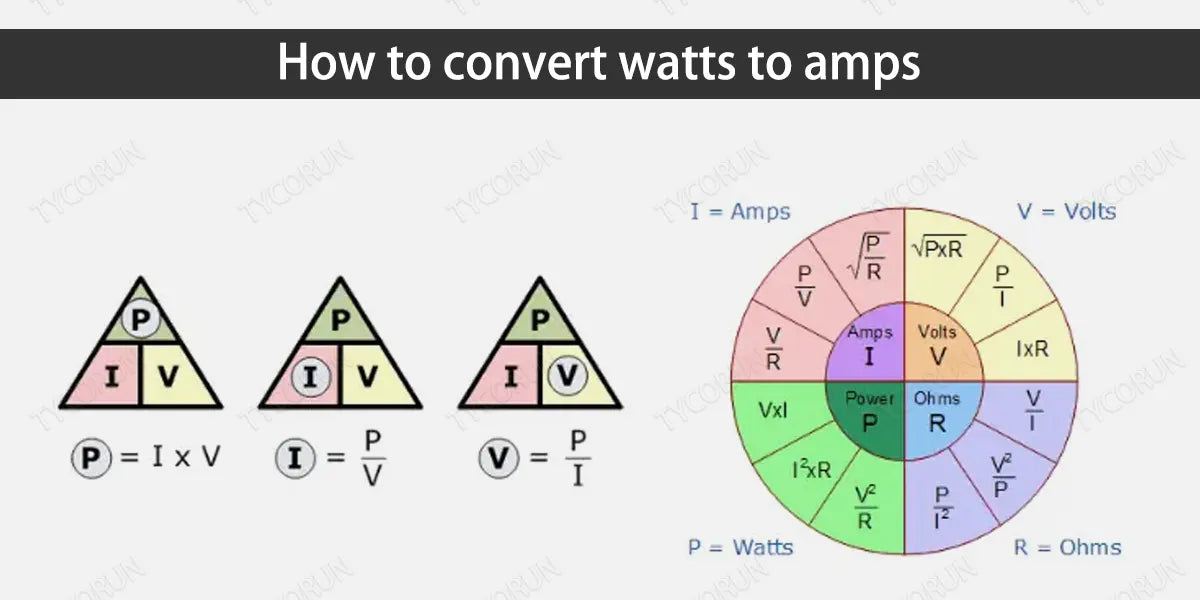
Amps = Watts ÷ Volts
Example: A 100W DC device on a 12V battery draws 100 ÷ 12 = 8.33A
AC Circuits (With Power Factor)
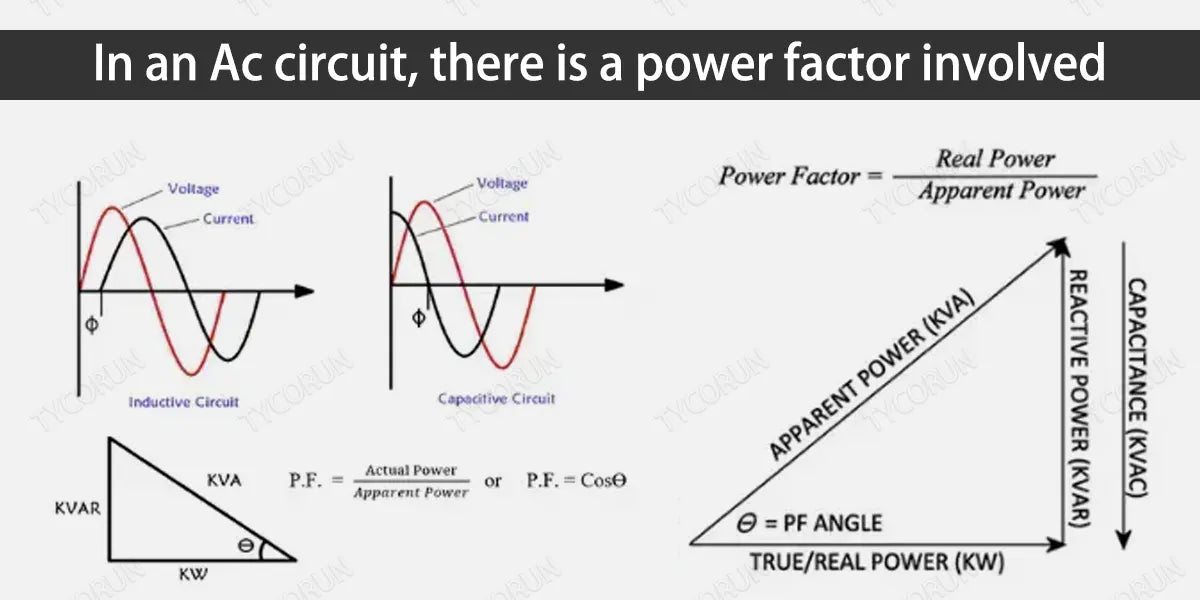
AC systems include a power factor (PF) — the ratio of real (usable) power to apparent power in the circuit, ranging from 0 to 1.0. A power factor of 1.0 means all delivered power converts to useful work; motors, transformers, and other inductive loads typically run below 1.0.
Amps = Watts ÷ (Volts × Power Factor)
Example: A 100W device on a 120V AC circuit with PF = 1: 100 ÷ (120 × 1) = 0.83A
How to Convert Amps to Watts
The formula simply flips:
Watts = Amps × Volts (DC)
Watts = Amps × Volts × Power Factor (AC)
Example (DC): 3A at 240V → 3 × 240 = 720W
Example (AC, PF = 1): 3A × 240V × 1 = 720W
Quick Watts to Amps Calculator (add calculator)
dfgvtdhbyj
⚡ Quick Watts to Amps Calculator
Watts to Amps Conversion Charts
120V (Standard US Household Circuit)
| Watts | Amps |
|---|---|
| 10 W | 0.083 A |
| 50 W | 0.417 A |
| 100 W | 0.833 A |
| 200 W | 1.667 A |
| 500 W | 4.167 A |
| 800 W | 6.667 A |
| 1000 W | 8.333 A |
240V (High-Power Appliances, EU/UK Household Standard)
| Watts | Amps |
|---|---|
| 100 W | 0.42 A |
| 500 W | 2.08 A |
| 1000 W | 4.17 A |
| 1500 W | 6.25 A |
| 2000 W | 8.33 A |
| 2500 W | 10.42 A |
| 3000 W | 12.5 A |
12V (Common for E-bike/Scooter Electronics, Small Batteries, Solar Panels)
| Watts | Amps |
|---|---|
| 50 W | 4.17 A |
| 100 W | 8.33 A |
| 150 W | 12.5 A |
| 200 W | 16.67 A |
| 300 W | 25 A |
| 500 W | 41.67 A |
| 1000 W | 83.33 A |
24V (Common for E-bikes, Golf Carts, Small Solar/Battery Systems)
| Watts | Amps |
|---|---|
| 100 W | 4.17 A |
| 200 W | 8.33 A |
| 500 W | 20.83 A |
| 1000 W | 41.67 A |
| 1500 W | 62.5 A |
| 2000 W | 83.33 A |
48V (Common for E-bikes, E-motorcycles, Home Battery Storage)
| Watts | Amps |
|---|---|
| 200 W | 4.17 A |
| 500 W | 10.42 A |
| 1000 W | 20.83 A |
| 1500 W | 31.25 A |
| 2000 W | 41.67 A |
| 3000 W | 62.5 A |
72V (Common for Electric Motorcycles and Higher-Power EVs)
| Watts | Amps |
|---|---|
| 500 W | 6.94 A |
| 1000 W | 13.89 A |
| 2000 W | 27.78 A |
| 3000 W | 41.67 A |
| 5000 W | 69.44 A |
Note: higher pack voltage is exactly why e-bikes, e-motorcycles, and EVs move from 12V/24V to 48V and 72V systems — the same power draws far fewer amps, which means thinner wiring, less heat, and higher efficiency.
Real-Life Watts to Amps Examples
The formula is simple, but it helps to see it applied to the kind of equipment people actually convert watts to amps for — EVs, battery packs, and swap infrastructure.
Electric Motorcycle Example
Take the TYCORUN CPX electric motorcycle as a real example: it's rated at 4,000W and runs on a 60V/72V battery-swapping system, using two swappable 72V 30Ah packs. Here's the current draw at full power on each voltage setting:
- At 72V: Amps = 4000 ÷ 72 = 55.6 A
- At 60V: Amps = 4000 ÷ 60 = 66.7 A
This is a good illustration of why higher-voltage packs are the more efficient choice for a given power rating: at the same 4,000W, the 72V setting draws over 11A less than the 60V setting, which means thinner cabling, less resistive heat, and better efficiency for the same ride.
Battery Pack
Take TYCORUN's 12V 100Ah lithium deep-cycle battery — a common choice for RVs, marine, and off-grid solar setups — powering a 100W portable fridge continuously. The current draw from the pack is:
Amps = Watts ÷ Volts = 100 ÷ 12 = 8.3 A
At a steady 8.3A draw, a 100Ah pack could theoretically run the fridge for about 12 hours (100 ÷ 8.3) before it's depleted — useful for estimating runtime once you already know the load in watts.
Battery Swap Cabinet
Take TYCORUN's 12-slot battery swap cabinet as a real example. Its key power specs:
| Item | Parameter |
| Chamber quantity | 12 slots |
| Battery voltage | 72V / 60V / 48V |
| Max power (total) | 9,600 W |
| Max power per slot | 800 W |
| Max charging current per slot | 15 A |
| Input voltage | 220V |
Converting each slot's max power (800W) to amps at each supported battery voltage shows how the per-slot current ceiling comes into play:
- At 72V: Amps = 800 ÷ 72 = 11.1 A
- At 60V: Amps = 800 ÷ 60 = 13.3 A
- At 48V: Amps = 800 ÷ 48 = 16.7 A
At 72V and 60V, the current stays comfortably under the cabinet's 15A per-slot ceiling, so the full 800W is achievable. But at 48V, 800W would require 16.7A — above the 15A limit — so the cabinet caps output there at 48 × 15 = 720W, slightly below its rated maximum.
On the input side, the cabinet's total max power across all 12 slots is 9,600W, drawn from a 220V AC mains supply:
Amps = Watts ÷ Volts = 9600 ÷ 220 = 43.6 A
This is exactly why converting watts to amps matters on both sides of a swap cabinet: undersized 220V input wiring, or an underestimated per-slot current ceiling on the battery side, can each become the bottleneck on charging performance.
Why AC Power Calculations Need a Power Factor
This is where many watts-to-amps calculators go wrong. A purely resistive AC load (a space heater, an incandescent bulb) has a power factor of essentially 1.0, so Watts = Amps × Volts works fine. But motors, HVAC compressors, transformers, and variable-frequency drives are inductive loads with a power factor typically between 0.8 and 0.95. Ignoring this in three-phase or industrial calculations can meaningfully understate real current draw and lead to undersized wiring or breakers.
Watts to Amps in Real Wiring: Why the NEC 80% Rule Matters
Converting a device's wattage to amps is only half the job when you're sizing a circuit, breaker, or extension cord — you also need a safety margin. The National Electrical Code's 80% rule recommends that circuit breakers not be loaded to more than 80% of their rated capacity for continuous loads, because breakers can overheat and fail if run at full capacity for extended periods. This is especially relevant for continuous, high-draw loads like EV chargers: NEC 625.41 requires EV charging equipment to be treated as a continuous load, so a Level 2 charger drawing 32A needs a minimum 40A circuit (32 × 1.25 = 40). So when converting a device's wattage to the amperage it will draw, always compare against 80% of the breaker's rating, not the full rating, for anything expected to run 3 hours or longer.
Understanding the Basics: Watts, Amps, Volts, and Ohm's Law
What Is a Watt?
A watt (W) is the SI unit of power — the rate at which electrical energy is generated, transferred, or dissipated. It's named after Scottish engineer James Watt (1736–1819), who advanced steam engine technology.
Formula: Watts (P) = Amps (I) × Volts (V)
Power can also be expressed using resistance:
- P = V² / R (power from voltage and resistance)
- P = I² × R (power from current and resistance)
What Is an Amp?
An ampere (A), or amp, measures electric current — the rate at which electric charge flows past a point in a circuit. It's named after French physicist André-Marie Ampère (1775–1836).
1 ampere = 1 coulomb of charge passing a point per second (1 A = 1 C/s).
1 coulomb ≈ 6.24 × 10¹⁸ elementary charges.
Since May 20, 2019, the ampere has been based on a fundamental physical constant: the elementary charge, the amount of electric charge carried by a single electron or proton. Before that date, the ampere was defined by a theoretical force between two infinitely long, infinitely thin wires — elegant on paper but nearly impossible to measure with high precision in a lab. Under the current definition, the ampere is fixed by setting the elementary charge to exactly 1.602176634 × 10⁻¹⁹ coulombs, tying the unit to an unchanging property of nature rather than a physical artifact.
What Is a Volt?
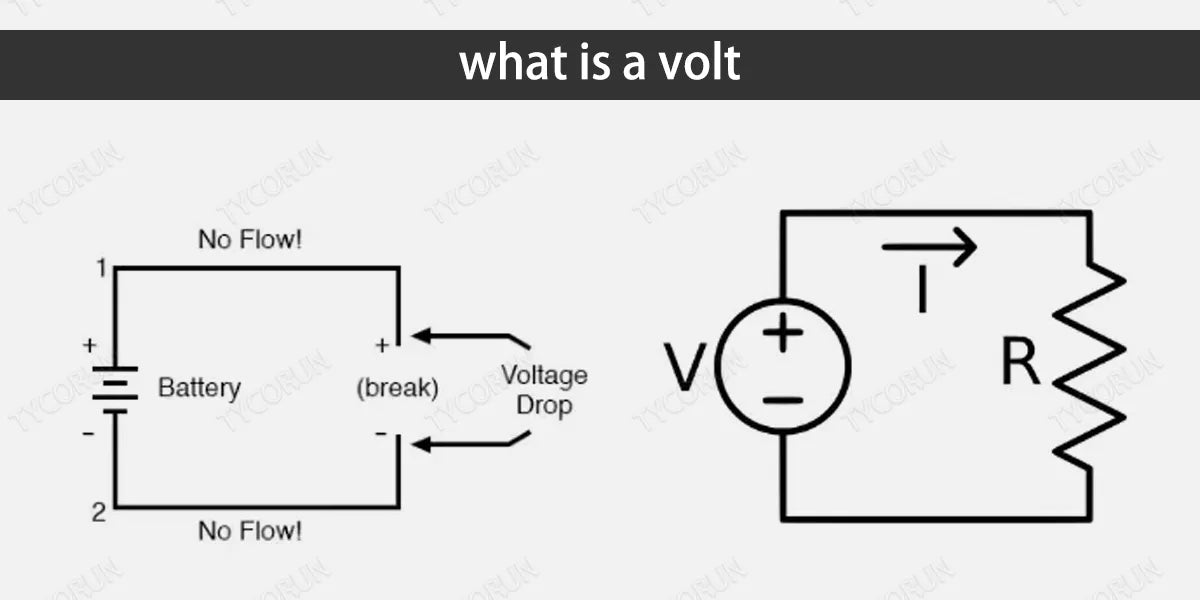
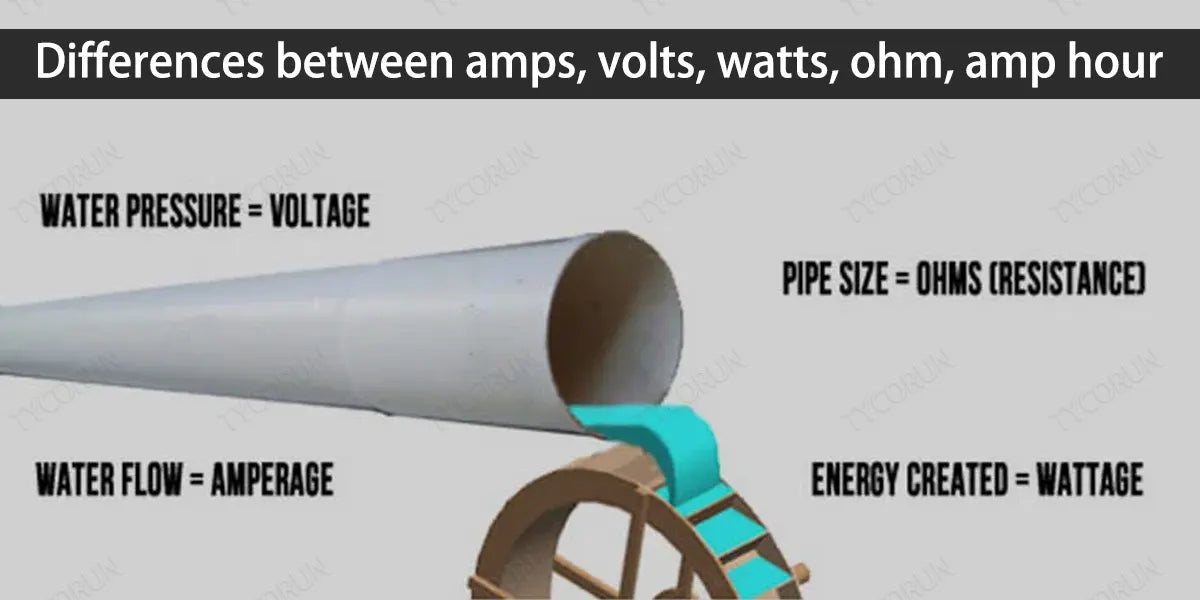
Voltage (V) is the electrical pressure that pushes current through a circuit — comparable to water pressure in a pipe. It's named after Italian physicist Alessandro Volta (1745–1827).
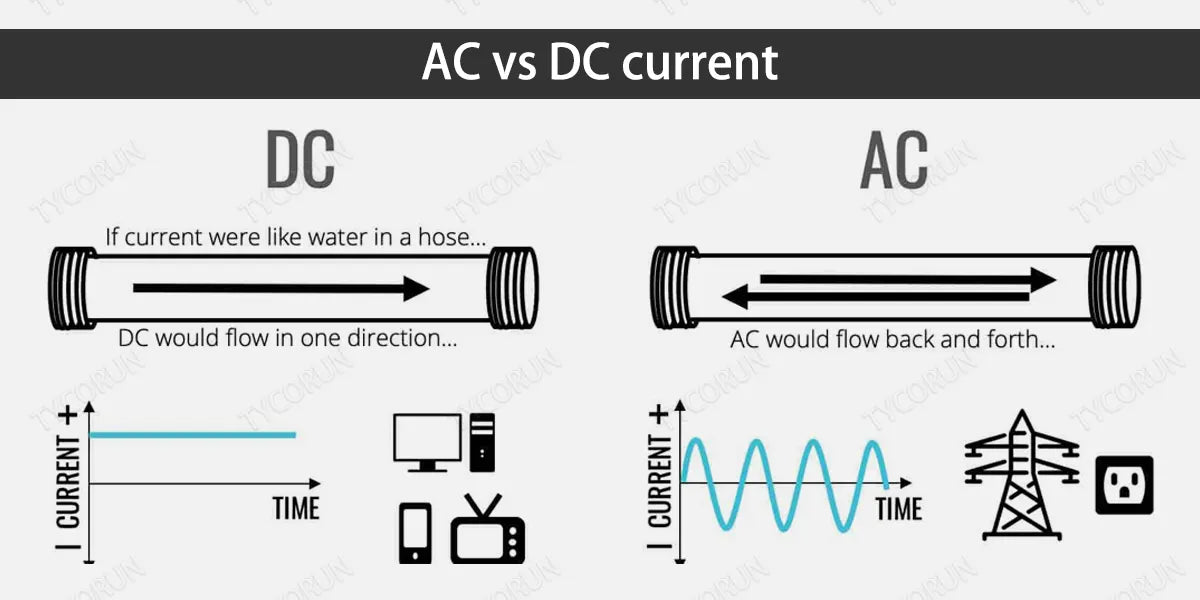
- DC voltage flows in one steady direction (batteries, solar panels, USB power).
- AC voltage oscillates in a wave, reversing direction at a fixed frequency (grid power, most home outlets — 60 Hz in the US, 50 Hz in most of the world).
How Watts, Amps, Volts, Ohms, and Amp-Hours Relate (Ohm's Law)
All of these units connect through Ohm's Law, formulated by Georg Ohm in 1827:
- Volts (V) = Amps (I) × Ohms (R)
- Amps (I) = Volts (V) ÷ Ohms (R)
- Ohms (R) = Volts (V) ÷ Amps (I)
- Watts (P) = Amps (I) × Volts (V)
Current is directly proportional to voltage and inversely proportional to resistance — higher resistance means less current flows for the same voltage.
Amp-hours (Ah), used to rate battery capacity, follow a related but distinct formula:
Amp-hours (Ah) = Current (I) × Discharge time (T, in hours)
A battery rated at 100Ah can theoretically supply 100A for 1 hour, 50A for 2 hours, or 1A for 100 hours (in practice, usable capacity drops somewhat at higher discharge rates).
Frequently Asked Questions
1. How many amps is 1000 watts?
At 120V: 1000 ÷ 120 = 8.33A. At 220V: 1000 ÷ 220 = 4.55A. At 48V (battery system): 1000 ÷ 48 = 20.83A.
2. How many amps is 2000 watts?
At 120V: 2000 ÷ 120 = 16.67A. At 220V: 2000 ÷ 220 = 9.09A. At 48V: 2000 ÷ 48 = 41.67A.
3. How many amps is 3000 watts?
At 120V: 3000 ÷ 120 = 25A. At 220V: 3000 ÷ 220 = 13.64A. At 72V: 3000 ÷ 72 = 41.67A.
4. What size breaker do I need for 1500 watts?
At 120V, 1500W draws 12.5A. Applying the NEC's 80% continuous-load rule, divide by 0.8: 12.5 ÷ 0.8 = 15.6A, so a 20A breaker is the standard safe choice.
5. Does high amps mean high watts?
Yes — at a constant voltage, amps and watts are directly proportional, so higher current means higher power.
6. How many amps is 60 watts?
If the voltage is 120V: Amps = 60 ÷ 120 = 0.5 A
7. How many watts is a 2.4 amp charger?
If the voltage is 5V: Watts = 2.4 × 5 = 12 W
8. What is 1500 watts to amps?
If the voltage is 124V: Amps = 1500 ÷ 124 = 12.5 A
Related articles: battery capacity, 18650 battery voltage, voltage vs current