Why Dubai Is a Demanding Market for Battery Swapping
Dubai’s delivery market runs on long shifts, heavy peak-hour demand and summer heat that puts real pressure on batteries and charging equipment. For electric delivery fleets, every long charging stop costs orders, and high temperatures affect how batteries and chargers perform. A battery swapping network here has to keep batteries charged, thermally stable and available close to where riders work.
Challenges
Terra was building a battery swapping network for electric motorcycle delivery operations in Dubai. The project required more than supplying vehicles or charging equipment alone. Batteries, swap stations, motorcycles and digital management systems needed to work together as one operating system.
-
High fleet utilization. Delivery motorcycles operate for long hours each day, making conventional charging difficult to fit into daily operations. Long charging periods can reduce vehicle availability and interrupt delivery schedules, especially during peak demand.
-
High-temperature operating environment. Dubai’s climate places additional demands on batteries, charging equipment and thermal management. The battery swapping system needed to support stable operation in hot conditions while keeping batteries circulating reliably.
-
Network and battery availability. As Terra expanded its fleet, it also needed to make sure charged batteries were available where riders needed them. This required coordinated management of swap stations, battery inventory, vehicles and operational data across the network.
Solution
Battery swap infrastructure
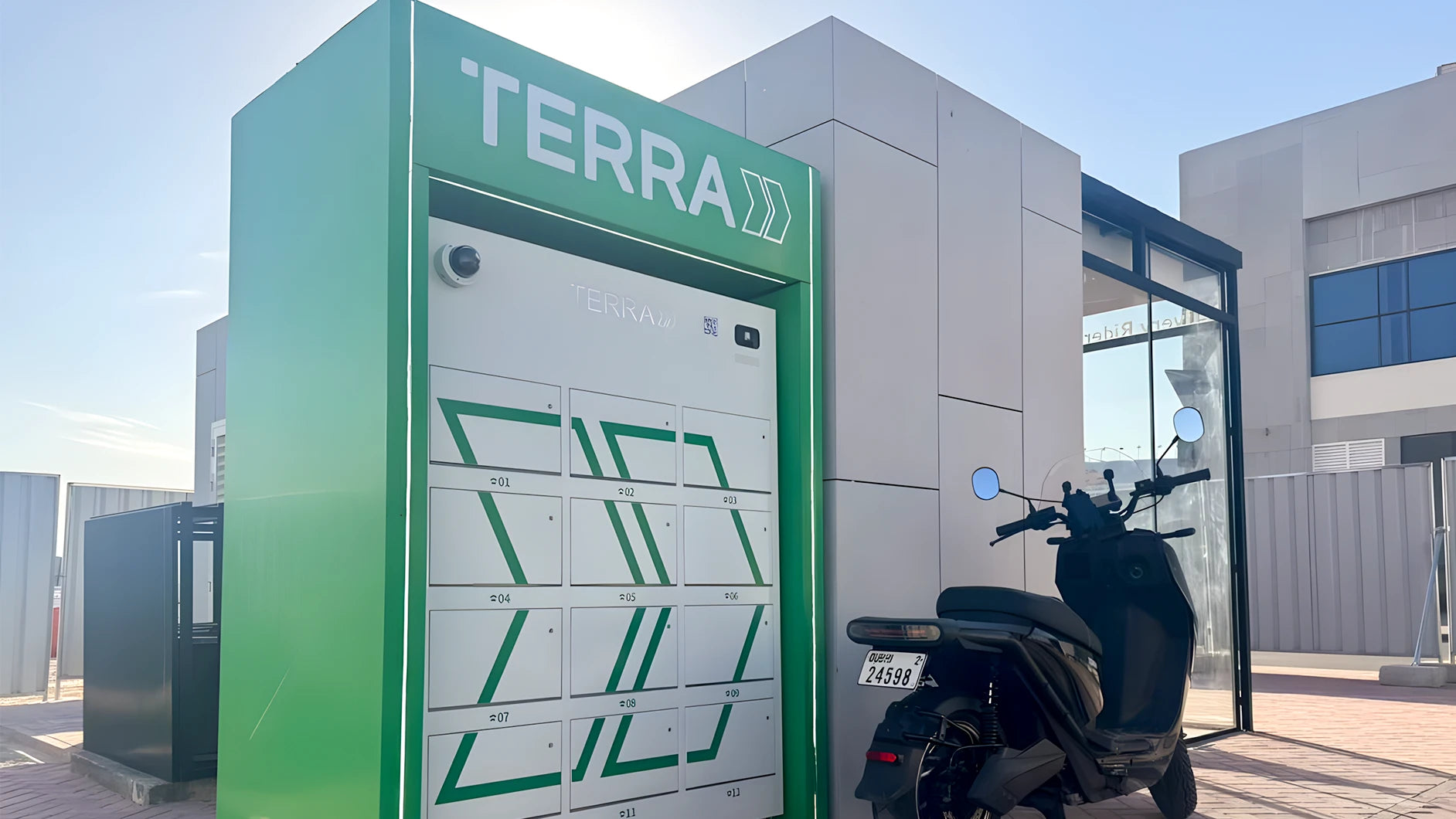
TYCORUN supplied 60 12-slot battery swap cabinets to support Terra’s battery swapping network in Dubai, which works out to one cabinet for every 20 motorcycles. The stations give riders fast access to charged batteries and remove the need for motorcycles to stay parked for conventional charging.
The project also included 3,300 swappable lithium batteries in a 76.8V 30Ah configuration and 1,200 electric motorcycles. The vehicle, battery and cabinet interfaces were configured as an integrated system, with a typical battery swap completed in approximately 30 seconds.
The 3,300 batteries cover a dual-battery, long-range configuration on each motorcycle, plus spare batteries held at stations and the hub to keep circulation running.
Cabinets and batteries configured for heat
Batteries, charging systems and swap cabinets were configured for Dubai’s high-temperature operating environment. The system uses thermal management and an adaptive, temperature-controlled charging strategy so that high-frequency charging and discharging stay within safe operating limits.
Electric motorcycle integration
The electric motorcycles were integrated with the battery swapping system and backend platform to support fleet operations. Vehicle and battery data can be used to monitor operating status and support maintenance and after-sales management.
TYCORUN also provides technical and warranty support for the supplied system, helping Terra maintain stable operation as the fleet continues to expand.
Digital operation management
A bilingual Arabic and English management system supports the operation of batteries, swap stations and vehicles. The platform records battery status, charging and discharging data, swap activity and station inventory, giving operators greater visibility across the network.
Battery operating data can also be used to identify abnormal conditions and support preventive maintenance. This allows operators to manage batteries based on their actual condition instead of relying only on fixed maintenance schedules. The system also supports station and battery inventory management, helping operators see where charged batteries are available and where additional support may be needed.
Local deployment and operational support
TYCORUN technical specialists took part directly in the local deployment in Dubai, working alongside the Terra team on system integration, equipment setup, operational training and technical support. Local participation allowed technical issues, operating requirements and system configuration to be addressed close to the actual deployment environment. TYCORUN continued to support Terra with bilingual system setup, training, maintenance coordination and ongoing technical service.
Ecosystem support
TYCORUN also supported Terra in connecting with regional industry and investment resources, including engagement with the Abu Dhabi Investment Office (ADIO) ecosystem and participation in Make it in the Emirates 2025. These activities supported Terra’s continued development as it expanded its battery swapping operations in the UAE.
Deployment Process
TYCORUN evaluated Terra’s delivery operations, local climate and deployment conditions to define the requirements for vehicles, batteries and swap stations. The system was then configured, tested, installed and integrated with the management platform.
From solution design to sample delivery took 28 days.
Project Results
The project established an integrated battery swapping system of 60 swap cabinets, 3,300 swappable batteries and 1,200 electric motorcycles, all deployed and operating in Dubai.
Lower energy costs. Energy costs were reduced by approximately 40%.
Estimated first-year ROI of 176%. This is an estimate based on TYCORUN’s project calculation. Actual results depend on fleet size, swap volume and local operating costs.
Capacity for peak periods. With one swap cabinet for every 20 vehicles, charging slots and battery inventory leave buffer capacity for peak demand.
Integrated fleet operations. Vehicles, batteries, swap stations and backend management are connected within one system, giving Terra greater visibility over battery circulation and network operations.
Foundation for expansion. The deployment gives Terra a scalable infrastructure base as its network continues to grow across Dubai and the wider UAE market.