
Quick Answer
The top 15 electric tricycle suppliers in China in 2026 include Jinpeng, Huaihai, Zongsen, Wuxing, Bodo, Loncin, Yadea, Lifan Industry, XINGE, MILG, Aima, Benlg, Haibao, Minghong, and KingChe. Jinpeng reports the highest production volume (1.5M+ units/year). Huaihai reports the #1 China market sales position for 13 consecutive years across 96 countries. For heavy mountain cargo, Zongsen and Lifan offer motor output up to 4000W. KingChe and MILG focus on OEM/ODM customization. Certifications to look for include CCC (China), CE (Europe), EEC (EU registration), and DOT (US market).
China produces most of the world's electric tricycles, supplying cargo, passenger, and utility models to fleets and distributors in 100+ countries. Key manufacturing hubs include Feng County (over 60% of output), Wuxi (R&D and exports), Chongqing (high-torque for hilly terrain), Shandong (integrated NEV supply chain), and Tianjin/Hebei (metal fabrication with port access).
These vehicles are widely exported across Asia and Africa for cost and durability, as well as the Middle East and Latin America for last-mile delivery. Adoption is also increasing in North America and Europe, supported by certifications such as EEC, CE, and DOT.
For fleet operators and distributors, choosing the wrong tricycle supplier leads to hidden costs: incompatible battery systems, unplanned vehicle downtime, and certification delays at customs. This guide helps you evaluate suppliers based on verifiable production data, export track record, and battery compatibility.
The global electric tricycles market is expanding at a CAGR of around 7–10%. Industry data shows Chinese exports are rising sharply, with one Jiangsu-based factory reporting nearly 70,000 units exported in 2025 — a 40% year-over-year increase.
This guide profiles 15 three-wheel electric vehicle factories and brands in China for 2026, covering each company's background and verified strengths — so importers, distributors, and fleet operators can identify the right manufacturing partner for their application.

Main content:
- Types of Electric Tricycles
- Quick Comparison Table
- Top 15 Electric Tricycle Manufacturers in China 2026
- Electric Tricycle Battery Types: Plug-in vs Swappable
- Battery Swap Solutions for Commercial Fleets
- How to Choose the Right Electric Tricycle Manufacturer
- Conclusion
-
FAQs
- Which is the largest electric tricycle manufacturer in China?
- What battery types do Chinese electric tricycles use?
- Which manufacturers offer swappable battery electric tricycles?
- What voltage is standard for cargo electric tricycles?
- What certifications should I look for when importing from China?
- How long does it take to charge an electric tricycle battery?
Types of Electric Tricycles
Electric tricycles serve a wide range of applications across personal mobility, commercial logistics, and specialized utility operations. Understanding the different types helps buyers select the right vehicle for their specific needs.
- Cargo / Freight Tricycles: Designed for last-mile delivery, logistics, and agricultural transport. Feature reinforced frames, large cargo boxes, and higher load capacities (200–800 kg). Examples: Jinpeng JW180, Lifan LF4000DZH, Yadea ET155H.
- Passenger / Commuter Tricycles: Used for urban transport, ride-hailing, and personal mobility. May include enclosed cabins for weather protection. Examples: Aima T3L, Haibao 60V 1500W.
- Utility / Special Purpose Tricycles: Built for specific applications including sanitation, municipal fleet operations, agricultural dumping, and industrial park transport. Examples: Loncin ET160, Benlg HARVEST.
Within these categories, vehicles can also be distinguished by drivetrain type — pure electric (battery-only) and hybrid electric (battery plus pedal assist or range extender) — with pure electric models dominating the commercial segment due to lower maintenance requirements and zero-emission operation in urban environments.
Quick Comparison Table
All 15 brands compared by main products, primary application, and notable characteristic — for importers, distributors, and fleet operators evaluating Chinese three-wheel EV suppliers in 2026.
| No | Brand | Main Products | Best For |
|---|---|---|---|
| 1 | Jinpeng | Cargo tricycles, leisure tricycles | Large-scale cargo distribution |
| 2 | Huaihai | Cargo & passenger tricycles | Large-volume export markets |
| 3 | Zongsen | Cargo tricycles, logistics vehicles | Heavy load / mountainous routes |
| 4 | Wuxing | Cargo tricycles | Urban delivery / agriculture |
| 5 | Bodo | Cargo tricycles, mobility vehicles | Cost-efficient cargo sourcing |
| 6 | Loncin | Cargo tricycles, sanitation vehicles | Fleet / sanitation vehicles |
| 7 | Yadea | Smart tricycles, cargo tricycles | Airport / warehouse logistics |
| 8 | Lifan Industry | Cargo tricycles, electric motorcycles | Long-range cargo delivery |
| 9 | XINGE | Cargo tricycles | Cost-effective logistics |
| 10 | MILG | Cargo tricycles, electric scooters | Heavy-duty commercial cargo |
| 11 | Aima | Passenger & cargo tricycles | Consumer / passenger mobility |
| 12 | Benlg | Agricultural & cargo tricycles | Agricultural / rural transport |
| 13 | Haibao | Enclosed canopy tricycles | Passenger urban transport |
| 14 | Minghong | Cargo & fleet export tricycles | Export / international fleet |
| 15 | KingChe | Electric tricycles, motorcycles | OEM / custom fleet programs |
Top 15 Electric Tricycle Manufacturers in China 2026
Jinpeng

| Founded | 2004 |
| Headquarters | Xuzhou, Jiangsu, China |
| Website | jinpeng-global.com |

Jinpeng’s official materials highlight a multi‑base manufacturing layout and large‑scale production capacity, with the company covering passenger and cargo tricycles, mobility scooters, four‑wheelers, garbage collection carts, and forklifts.
This brand is better viewed as a scale‑oriented supplier rather than a customization‑first partner, making it suitable for buyers who prioritize stable delivery and standardized vehicle models. Jinpeng has built an extensive distributor network across the Americas, Europe, Asia, and Africa, and it holds a substantial patent portfolio along with numerous provincial and municipal technology awards.
Claims about production volume are based on company disclosures, so buyers should verify model‑specific certifications (such as CE or EEC) directly with the factory before placing orders.

Huaihai

| Founded | 1976 |
| Headquarters | Xuzhou, Jiangsu, China |
| Website | huaihaiglobal.com |

Huaihai’s public materials place greater emphasis on its long‑term market presence and overseas expansion, operating three brands (Huaihai, Zongshen, Hoann) across small electric vehicles and logistics tricycles.
For buyers seeking export network support and multi‑country local assembly, Huaihai is a relevant option, as the company runs manufacturing bases in China plus overseas facilities in Pakistan, India, Chile, Peru, and Indonesia. A notable aspect of Huaihai’s strategy is its joint venture with BYD to develop sodium‑ion battery technology for mini‑vehicles, though this is not yet in mass production.
The claimed market leadership and substantial global sales figures are company‑disclosed, so importers should confirm current product availability and model‑specific certifications for their target region directly with Huaihai.

Zongsen

| Founded | 1982 |
| Headquarters | Chongqing, China |
| Website | zonsenmotor.com |

Zonsen’s official positioning focuses on its integrated motorcycle and three‑wheeler manufacturing background, with a co‑branding arrangement with Italy’s Piaggio Group.
For buyers prioritizing heavy‑load and mountainous route performance, Zonsen is a suitable option, as the company’s Chongqing location serves as a demanding real‑world test environment for steep‑grade cargo delivery. Zonsen offers OEM/ODM/CKD services and has a reported global sales volume that places it among the larger players, though this figure is based on internal records.
The company also manufactures special‑purpose vehicles and core components. Buyers should verify certification (EEC, etc.) on a model‑by‑model basis directly with the factory, as these vary by destination market.

Wuxing

| Founded | 1997 |
| Headquarters | Weifang, Shandong, China |
| Website | wuxingcl.com |

Wuxing concentrates on heavy‑duty electric tricycles for industrial, agricultural, and off‑road transport environments, operating as a production and development base of Weichai Rewo. For urban delivery and agricultural operators who need anti‑corrosion frames and structural durability rather than high‑speed passenger designs, this is a brand to consider.
The company employs a substantial workforce and operates a large factory in Shandong, a major electric tricycle supply chain hub. Wuxing has an established export track record to Asia and Africa. Capacity claims are company‑reported, and buyers should verify whether specific models carry CE or EEC certification for their destination market before ordering.

Bodo

| Founded | 1997 |
| Headquarters | Tianjin, China |
| Website | bodo-electricbicycles.com |

Bodo (Baodao Automobile Group) markets itself as a vertically integrated manufacturer with production bases in China, Germany, Czech Republic, and Bulgaria, covering electric bicycles, scooters, three‑wheelers, and electric cars.
For buyers seeking cost‑efficient cargo sourcing with OEM/ODM/CKD flexibility, Bodo is a relevant option, as it manufactures its own motors, controllers, and frames to control costs. The company reports a significant annual EV capacity across its domestic bases, with overseas assembly centers in Europe.
However, the actual capabilities of its European facilities (full manufacturing versus final assembly) should be verified directly with Bodo. Additionally, model‑specific certifications must be confirmed per destination market, as standards vary.

Loncin

| Founded | 1993 |
| Headquarters | Chongqing, China |
| Website | loncinindustries.com |

Loncin is an industrial group with a heritage in gasoline engines and a long‑standing contract manufacturing relationship with BMW Motorrad, producing engine components and complete engines under BMW specifications. This background allows Loncin to apply automotive‑grade production standards (including higher‑specification welding and coating) to its cargo tricycles, ATVs, sanitation vehicles, and UTVs.
For fleet buyers — especially municipal and sanitation fleets — who value industrial engineering credentials and established distribution in African and Southeast Asian markets, Loncin is a brand to consider.
That said, electric tricycles represent a smaller portion of Loncin’s overall product mix compared to engines and two‑wheelers, so buyers should request model‑specific certification and test reports for the intended application.

Yadea

| Founded | 2001 |
| Headquarters | Wuxi, Jiangsu, China |
| Website | yadea.com.cn |

Yadea, a Hong Kong‑listed electric two‑wheeler brand that also produces tricycle variants, emphasizes scale with multiple domestic production sites plus additional facilities in Vietnam and Indonesia, and an extensive sales network covering tens of thousands of points of sale across China.
For airport or warehouse logistics operators who need a large after‑sales network and regionally optimised supply, Yadea is a relevant option.
Tricycles are also a smaller share of Yadea’s output compared to two‑wheelers, so buyers should confirm a model availability for tricycle orders.

Lifan Industry

| Founded | 1992 |
| Headquarters | Chongqing, China |
| Website | lifanmotos.net |

Lifan is a traditional motorcycle and automobile manufacturer that underwent a significant restructuring after 2020 with involvement from Geely’s founder, pivoting to electric vehicle production including cargo tricycles with high motor output and lithium‑ion configurations.
For buyers seeking long‑range cargo delivery vehicles, Lifan is a brand to consider, as it holds certifications such as CCC, CE, and ISO 9001, and has a distribution network built on decades of export experience in motorcycles and engines.
However, buyers should request recent production records, arrange sample testing, and verify model‑specific certifications before placing bulk orders.

XINGE

| Founded | 1987 |
| Headquarters | Xinxiang, Henan, China |
| Website | xin-ge.com.cn |

XINGE has manufactured motorcycles and cargo tricycles continuously since 1987, based in Xinxiang, Henan Province — a region often called “China’s three‑wheeler capital” due to its highly concentrated EV component supply chain.
For cost‑effective logistics operators who value long production history and fast component access from a local cluster, XINGE is a suitable option. The company reports a substantial annual capacity for three‑wheeled vehicles and exports to many countries across Asia, Africa, and beyond, holding ISO 9001, ISO14001, OHSMS18001, and CCC certifications.
The longevity and sales leadership claims are company‑reported, so buyers should verify which specific models are currently in production and hold required export certifications for their destination market.

MILG

| Founded | 2010 |
| Headquarters | China |
| Website | milgev.com |

MILG positions itself as an early Chinese EV exporter to South America and the European Union, holding a wide range of international certifications (including ISO 9001, CCC, CE, EEC, DOT, and WMI) and operating two standardized assembly lines with an in‑house R&D team.
For heavy‑duty commercial cargo buyers needing EEC‑certified models for European registration or DOT‑certified models for the US market, MILG is a relevant option. The company has nearly two decades of export experience and is recognized as an Alibaba Gold Supplier.
However, buyers should verify current model‑specific certifications for their destination country, as regulations change over time, and not every model holds every certification.

Aima

| Founded | 1999 |
| Headquarters | Tianjin, China |
| Website | aima.com |

Aima is a consumer‑oriented electric vehicle brand with a large global retail footprint, multiple production bases, and an intelligent R&D center.
For passenger or light‑cargo tricycle buyers in consumer or ride‑hailing segments who value removable battery designs, smart features (digital displays, anti‑theft systems), and brand recognition, Aima is a suitable option. The company has received sales‑based certifications from third‑party organizations, and its cumulative sales across all product types (bicycles, two‑wheelers, tricycles) are substantial.

Benlg

| Founded | 2000 |
| Headquarters | China |
| Website | benlg.com |

Benlg focuses on cargo and agricultural tricycles for rural transport markets, holding US DOT, EU E‑MARK, and ISO9001 certifications, with more than 30 registered patents.
For agricultural operators or rural logistics providers who need certified vehicles and local support, Benlg is a relevant choice, as the company has won government procurement bids for city patrol vehicles in multiple Chinese cities and operates international branches in India, the Philippines, Thailand, and Indonesia. Benlg’s published technical content on motor selection and controller sizing indicates a B2B‑oriented customer support approach.
However, DOT and E‑MARK certifications apply only to specific models — not the entire range — so buyers must verify the exact model’s certification for their destination market before ordering.

Haibao

| Founded | 2011 |
| Headquarters | Linyi, Shandong, China |
| Website | haibaobike.com |

Haibao (brand of Shandong Bus New Energy Vehicle) specializes in enclosed canopy tricycles for urban passenger mobility and holds MIIT registration for road‑legal vehicles in China.
For importers seeking fully enclosed passenger tricycles with DOT certification available on select export configurations, Haibao is a relevant option. The company has made a substantial investment in its industrial park, operates across three series and many models, and owns three brands (Haibao, Jindi, Tanta).
Its reported annual production covers all three brands and vehicle types, not exclusively tricycles, so buyers should confirm DOT availability per model directly with the factory and verify that the specific configuration meets their local road safety standards.

Minghong

| Founded | 1995 |
| Headquarters | Southwest China |
| Website | minghongmotors.com |

Minghong has over three decades of tricycle manufacturing experience and was selected as a UNDP supplier in 2018, deploying a substantial number of vehicles in Cuba to replace fuel‑powered motorcycles.
For international fleet operators and NGO tenders, Minghong is a particularly suitable option, as it exports to many countries and holds ISO 9001, CCC, RoHS, SGS, and CE certifications. The company also offers solar‑compatible designs and has developed a vehicle management platform through a subsidiary.

KingChe

| Founded | 2010 |
| Headquarters | Wuxi, Jiangsu, China |
| Website | kingchebike.com |

KingChe actively markets itself as an OEM/ODM/SKD/CKD partner, with a large number of product models developed since its factory was established in Wuxi, a major EV manufacturing hub.
For buyers who need full customization, flexible assembly options (CKD/SKD for local assembly), KingChe is a relevant option. The company has dealer partnerships across Europe, the Americas, and Asia, sponsors Chinese electric motorcycle competitions, and offers motor power across a wide spectrum.
However, KingChe’s strength is flexibility and rapid product iteration rather than high‑volume production stability. Buyers should confirm EEC certification for specific target markets and verify production lead times directly with the factory, as these can vary significantly depending on the customization level.

Electric Tricycle Battery Types: Plug-in vs Swappable
Battery performance directly affects vehicle range, operating efficiency, and long-term maintenance costs. Most three-wheel EVs in China use lead-acid or lithium battery systems, each suited to different use cases.
| Battery Type | Description | Advantages | Limitations |
|---|---|---|---|
| Lead-Acid | Standard in entry-level cargo and rural vehicles. Simple to charge, widely serviceable. | Low upfront cost; widely available; easy replacement | Heavier weight; shorter cycle life (~300–500 cycles); 8–10 hr charge time |
| Lithium (LiFePO4 / Li-ion) | Used in commercial and long-distance operations. Higher energy density per kilogram. | Lighter weight; longer cycle life (2,000–5,000+ cycles); 6–8 hr charge | Higher initial purchase cost |
| Swappable Battery (cabinet-based) | Used in high-utilization fleet operations. Depleted battery replaced at a swap station in under 2 minutes. | Zero charging downtime; BaaS model reduces upfront cost; 24/7 vehicle availability | Requires swap station infrastructure or BaaS partnership |
All 15 brands profiled in this guide use conventional plug-in charging as their standard configuration. For fleet operators running multiple daily shifts — in last-mile delivery, ride-hailing, or logistics — battery swap systems eliminate charging downtime entirely. Battery-as-a-Service (BaaS) models convert battery cost from capital expenditure into a per-swap or monthly subscription operating cost, reducing fleet entry cost significantly.
Battery Swap Solutions for Commercial Fleets
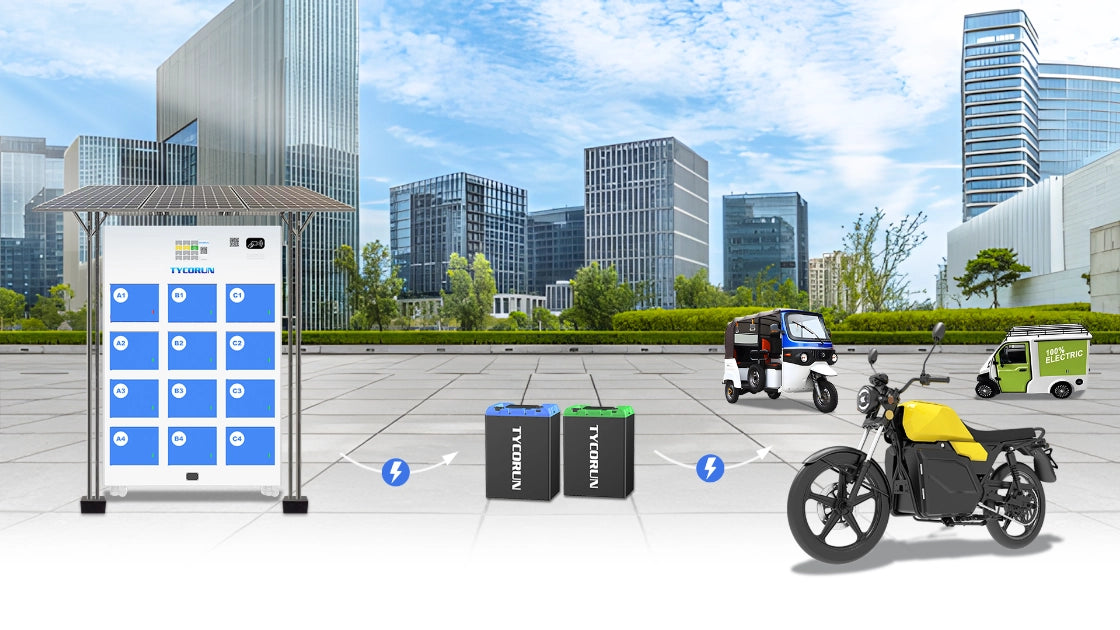
For operators requiring high-utilization continuous operation, purpose-built battery swap systems provide a complete operational platform beyond standard plug-in charging. TYCORUN Energy offers a one-stop battery swap station solution for last-mile logistics, food delivery, and commercial mobility scenarios.
TYCORUN Battery Swap System Components
- Intelligent Battery Swapping Cabinets: Self-developed dynamic power charging control systems, multi-layer safety alarms, and multi-voltage, multi-slot configurations supporting simultaneous swaps for multiple users.
- Standardized Swappable Batteries: LiFePO4 batteries (e.g., 48V 24Ah, 55V 45Ah) with built-in 4G modules, IP67 waterproofing, and semi-solid technology for high-frequency charge-discharge cycles.
- Cloud-Based Management Platform: Real-time monitoring of battery health, location tracking, cabinet inventory, deposit management, and usage analytics.
- User Mobile App: Guides riders through deposits, swap plan selection, and battery exchange in under two minutes.
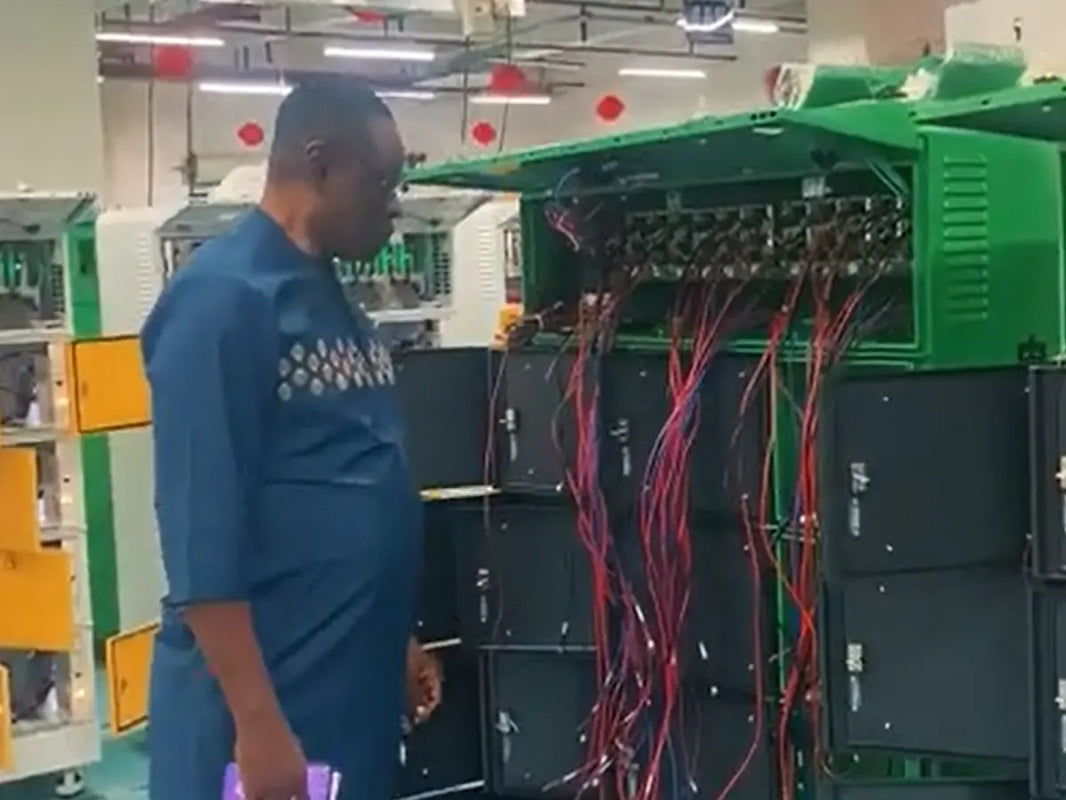
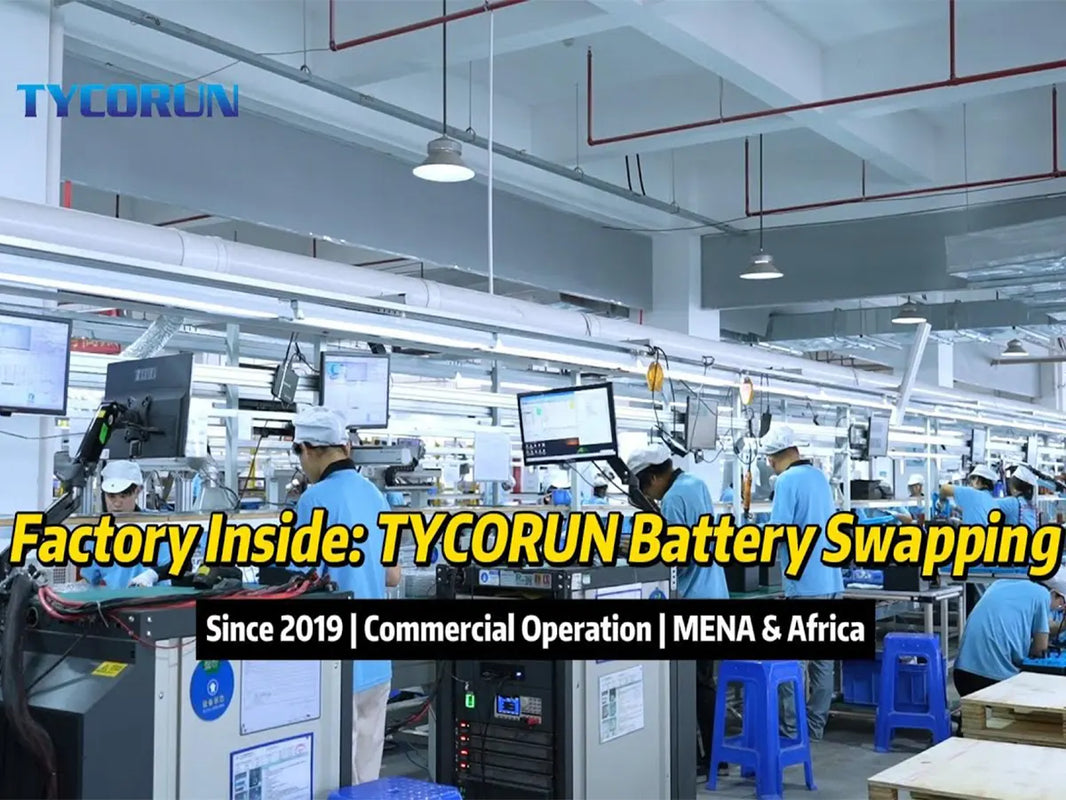
TYCORUN's solution has been deployed across more than 50 sets of 12-slot intelligent battery swapping cabinets, supporting 1,200 electric motorcycles and 3,300 batteries as of 2025, with after-sales support in approximately 48 countries. The system is compatible with a wide range of electric tricycles, motorcycles, and low-speed four-wheel vehicles, with OEM customization available for batteries, cabinets, and mobile app interfaces.
TYCORUN Energy provides end-to-end battery swap solutions — from smart cabinets and swappable batteries to cloud management platforms and ROI modeling. Visit TYCORUN Official Website to request a quote.
How to Choose the Right Electric Tricycle Manufacturer
- Certifications: CCC (China domestic), CE (Europe general), EEC (EU vehicle registration), DOT (US market). Verify the specific model — not just the company — holds the required certification for your destination market.
- Battery configuration: Confirm lithium options, operating voltage (48V/60V/72V), and whether swappable or removable configurations are available for your fleet use case.
- Motor output and load rating: Urban delivery: 800W–1000W at 60V is typical. Heavy cargo or mountain routes: 1500W–4000W at 72V. Confirm with the supplier before ordering.
- After-sales support: Verify parts availability in your market, warranty coverage, and whether the manufacturer has regional service partners or local branches.
- MOQ and lead time: These vary by manufacturer and model — confirm directly with your target supplier, as figures differ significantly across the 15 companies listed here.
Conclusion
China's three-wheel EV sector covers the full range of commercial applications — from Jinpeng's high-volume cargo models and Huaihai's export network to Minghong's UNDP-contracted fleet vehicles and KingChe's OEM customization programs. For most buyers, supplier selection depends on the target application, battery configuration requirements, and destination market certifications. Verifying production data, export history, and model-specific certification directly with each supplier remains the most reliable evaluation approach.
FAQs
Which is the largest electric tricycle manufacturer in China?
By reported production volume, Jinpeng claims capacity exceeding 3 million units per year across 16 factories. Huaihai reports #1 market sales position in China's small vehicle segment for 13 consecutive years. Both claims are based on company disclosures and have not been independently audited.
What battery types do Chinese electric tricycles use?
Most use lead-acid batteries (48V–72V) as standard due to lower upfront cost. Lithium-ion and LiFePO4 options are available from several suppliers including Lifan, Aima, and Minghong, offering longer cycle life and lower weight. Note: not all brands manufacture their own battery cells — Yadea, for example, sources cells from external suppliers for the majority of its product lines.
Which manufacturers offer swappable battery electric tricycles?
The brands profiled in this guide use plug-in charging as their standard configuration. Fleet operators requiring swappable systems can integrate purpose-built solutions such as TYCORUN's battery swap cabinets and standardized batteries, which are compatible with most three-wheel EVs on this list, enabling 30–120 second swaps without requiring factory-built swap capability from the OEM.
What voltage is standard for cargo electric tricycles?
60V is the most common configuration for commercial cargo applications (800W–1200W motors). 72V is used for higher-output applications requiring more torque or extended range.
What certifications should I look for when importing from China?
CCC (China domestic), CE (general European compliance), EEC (EU vehicle type approval for registration), DOT (US market). Always verify that the specific model — not just the brand — holds the certification required for your destination market before placing a production order.
How long does it take to charge an electric tricycle battery?
Lead-acid (60V/45–60Ah): typically 8–10 hours from a standard 220V outlet. Lithium-ion configurations generally charge in 6–8 hours. Some lithium-equipped models support faster charging (2–4 hours) where the battery management system permits higher charge rates — confirm with the specific supplier.
Who We Are
At TYCORUN, we specialize in lithium battery manufacturing and offer one-stop battery swap solutions for fleet operators, energy service providers, and mobility businesses worldwide. Committed to R&D, production, and deployment of lithium battery packs, intelligent swap cabinets, and battery management systems (BMS) since 2019. With deployments in 40+ countries and certifications including UN38.3, MSDS, CE, and UL, TYCORUN supports OEM/ODM integration and provides technical support throughout deployment. Contact Us to discuss your fleet energy requirements.

Related articles: Battery swapping station classification, Battery swapping station cost, Top 10 electric scooters with swappable batteries in the world