
Quick Answer: The top 10 battery swapping companies in India in 2026 are Battery Smart, SUN Mobility, VoltUp, ChargeUp, RACE Energy, Bounce Infinity, Lithion Power, Yuma Energy, Mooving, and BatteryPool. Battery Smart leads with 1,569+ active swap stations, over 281,000 circulating batteries, and 100 million historical swaps. SUN Mobility pioneered the Battery-as-a-Service (BaaS) model with 600+ Quick Interchange Stations. These companies collectively serve electric two-wheelers, three-wheelers, and commercial fleets across India.
For fleet operators and logistics businesses evaluating electric vehicle adoption in India, battery swapping infrastructure has become a critical operational variable. Charging time — which ranges from 30 minutes for fast chargers to 8 hours for home chargers — directly limits vehicle utilization and increases per-delivery costs. Battery swapping eliminates this constraint entirely: a full battery exchange takes 60–120 seconds, keeping commercial vehicles on the road and revenue-generating throughout the working day.
India's swap network has scaled significantly. According to the India Battery Swapping Association, India's battery-swapping boom hinges on deliveries and rickshaws — the vehicle segments that account for nearly 80% of India's commercial EV fleet. India is likely to require more than 26,000 swapping kiosks by the end of the current fiscal year, which runs through March 2026, and roughly 111,000 by FY2030. For businesses running delivery, ride-hailing, or last-mile logistics operations, selecting the right swap partner determines fleet uptime, operating cost, and geographic coverage. This article introduces the top 10 battery swapping companies in India in 2026, evaluated by network scale, B2B fleet compatibility, operational reliability, and deployment coverage.
In this article, we introduce Battery Smart, SUN Mobility, VoltUp, ChargeUp, RACE Energy, Bounce Infinity, Lithion Power, Yuma Energy, Mooving, and BatteryPool.

Main content:
Quick Comparison Table
All 10 companies evaluated by network scale, primary fleet segment, geographic coverage, and key operational differentiator for B2B operators.
| # | Company | Fleet Segment | Network Scale | Key Differentiator |
|---|---|---|---|---|
| 1 | Battery Smart | 2W & 3W | 1,569+ stations | Largest swap network; 100M+ historical swaps |
| 2 | SUN Mobility | Multi-vehicle | 600+ QIS stations | BaaS pioneer; IoT fleet management |
| 3 | VoltUp | Urban 2W & 3W | Growing urban | Pay-per-swap; real-time app availability |
| 4 | ChargeUp | E-rickshaws | Growing | AI demand forecasting; low idle cost |
| 5 | RACE Energy | Commercial EVs | South India | Engineering-led; retrofit kits for existing EVs |
| 6 | Bounce Infinity | Scooter fleets | Multi-city | Decoupled vehicle + battery pricing |
| 7 | Lithion Power | B2B operators | Delhi NCR | Software platform + $1B expansion plan |
| 8 | Yuma Energy | 2W & 3W fleets | 2,000+ stations, 17 cities | 99.9% uptime; 50M+ swaps completed |
| 9 | Mooving | Last-mile logistics | 500+ via HPCL partnership | Fully automated; HPCL network access |
| 10 | BatteryPool | EV fleet operators | Pune, Delhi NCR | Battery-agnostic SaaS + FinTech payment layer |
What Makes a Battery Swapping Network Effective?
For fleet operators evaluating battery swapping partners in India, network performance depends on more than station count. The following factors directly determine whether a swapping operator can support high-utilization commercial operations:
- Station density and geographic coverage — swap points must be distributed across a fleet's operational routes; gaps in coverage create downtime and defeat the operational benefit
- Swap speed — leading operators complete a full battery exchange in 60–120 seconds; slow swap processes reduce vehicle utilization per shift
- Battery interoperability — multi-brand compatible batteries reduce vehicle procurement constraints and allow fleets to expand without being locked to a single OEM
- Network uptime and battery health monitoring — IoT-connected systems track charge cycles, temperature, and degradation rate; operators with high uptime (99%+) minimize unplanned vehicle stops
- Business model flexibility — BaaS subscriptions, pay-per-swap, and fleet contracts serve different operational scales; operators that offer multiple commercial models reduce switching friction
- Behind-station recharge speed — the rate at which depleted batteries cycle back into availability determines how many swaps a station can support per shift
Top 10 Battery Swapping Companies in India 2026
Battery Smart

|
Company website |
|
|
Founded in |
2020 |

Company Overview
Battery Smart is the largest battery swapping operator in India by active station count. Since launching its first swap point in June 2020, the company has grown to 1,569+ active stations, with over 281,000 batteries in active circulation and more than 100 million completed swaps. Its network is concentrated in high-demand urban markets including Delhi NCR, Mumbai, Bengaluru, Hyderabad, Jaipur, and Lucknow, giving fleet operators in these cities consistent access across delivery routes.
Battery Smart's asset-light franchise model enables rapid geographic expansion by partnering with local businesses — kirana stores, petrol stations, and shops — to host swap points. This approach reduces capital requirements and allows the network to grow at a pace that vertically integrated competitors cannot match. For fleet operators, this translates into denser urban coverage and a lower likelihood of swap point gaps on active routes.

Key Advantages for Fleet Operators
- Network coverage: 1,569+ active stations across Delhi NCR, Mumbai, Bengaluru, Hyderabad, Jaipur, Lucknow, and more
- Swap speed: Full battery exchange in approximately 2 minutes
- BaaS subscription: Reduces ongoing energy costs for high-frequency riders and delivery fleets
- Interoperability: Compatible batteries across multiple supported vehicle models
- Proven scale: 100 million+ historical swaps demonstrating operational reliability at volume
SUN Mobility

|
Company website |
|
|
Founded in |
2017 |

Company Overview
SUN Mobility is one of India's earliest and most technically sophisticated battery swapping operators, founded in 2017. It pioneered the Battery-as-a-Service (BaaS) model in India — decoupling the battery from the vehicle purchase price to reduce total fleet acquisition costs. Its Quick Interchange Stations (QIS) are deployed across 600+ locations nationally, with strong presence in Delhi NCR, Bengaluru, Hyderabad, and Pune.
SUN Mobility's IoT-enabled platform gives fleet managers real-time visibility into battery health, charge status, and asset location across the entire deployed battery pool. This level of operational intelligence reduces unplanned vehicle stops and supports predictive maintenance — critical capabilities for logistics fleets running tight delivery windows.

Key Advantages for Fleet Operators
- Multi-OEM compatibility: Batteries and stations compatible with several vehicle brands, reducing procurement lock-in
- Fleet management platform: Cloud-connected IoT system for real-time battery monitoring and asset tracking
- Scale: 600+ Quick Interchange Stations across Delhi NCR, Bengaluru, Hyderabad, Pune, and other major cities
- Commercial fleet focus: Partnerships with auto-rickshaw manufacturers, bus operators, and logistics companies
VoltUp

|
Company website |
|
|
Founded in |
2019 |

Company Overview
VoltUp is a battery swapping operator focused on urban two- and three-wheeler fleets, offering a pay-as-you-go model that suits operators with variable daily utilization — including gig delivery workers and small fleet businesses that cannot commit to fixed subscription costs. The company deploys IoT-enabled lithium-ion batteries with modular swap stations and a mobile app displaying real-time battery availability across the network.
For fleet operators managing mixed-utilization vehicles, VoltUp's no-commitment pricing model reduces wasted spend on days when vehicles are not in service — a practical advantage over flat-rate subscription operators.

Key Advantages for Fleet Operators
- Flexible cost structure: Pay-per-swap pricing with no fixed monthly commitment
- Real-time availability: Mobile app shows live battery stock at each station, reducing search time
- Urban coverage: Stations positioned in high-traffic urban zones across Mumbai and other cities
- Compatible with mixed fleets: Suitable for operators managing varying daily vehicle dispatch volumes
ChargeUp

|
Company website |
|
|
Founded in |
2019 |

Company Overview
ChargeUp differentiates itself from other swap operators through applied AI. While most networks compete on station density, ChargeUp layers machine learning models onto its infrastructure to forecast swap demand by time and location, optimize battery inventory distribution, and reduce idle charging costs. This AI-driven approach makes its stations more cost-efficient to operate and more reliable for high-utilization e-rickshaw and scooter fleets in Delhi NCR and other northern Indian cities.
For B2B operators running e-rickshaw fleets in Tier-1 and Tier-2 cities, ChargeUp's demand-adaptive model means consistently higher battery availability during peak hours — reducing the risk of vehicle downtime during high-revenue periods.

Key Advantages for Fleet Operators
- AI-driven inventory management: ML demand prediction reduces battery shortages and idle charging costs
- Affordable fleet plans: Subscription pricing targeted at high-frequency e-rickshaw and scooter operators
- Commercial reliability: Consistent battery availability during peak hours in Delhi NCR and surrounding areas
- Scalable infrastructure: Growing station count in urban hubs across North India
RACE Energy

|
Company website |
|
|
Founded in |
2019 |

Company Overview
RACE Energy applies an engineering-first approach to battery design and swap station deployment, with founders from motorsport and advanced manufacturing backgrounds. The company's battery packs are built to withstand the intensive daily charge cycles of commercial three-wheelers and light commercial EVs — the segment most prone to early battery degradation in high-utilization delivery operations. RACE Energy operates primarily in Bengaluru, Chennai, and other South Indian cities, with broader national rollout plans underway.
A key differentiator for existing fleet operators: RACE Energy offers retrofit and conversion kits that allow non-swappable EVs to be adapted for swap compatibility. This eliminates the need to replace an entire fleet in order to access swapping infrastructure — a practical option for businesses with existing EV assets.

Key Advantages for Fleet Operators
- Commercial-grade battery durability: Packs engineered for high daily cycle counts under heavy load
- Retrofit compatibility: Existing non-swappable EVs can be converted without full fleet replacement
- South India coverage: Active network in Bengaluru, Chennai, and surrounding cities
- Lower long-term battery replacement cost: Engineering quality reduces degradation rate over operational lifetime
Bounce Infinity

|
Company website |
|
|
Founded in |
2014 |

Company Overview
Bounce Infinity was among the first Indian operators to integrate battery swapping directly into a consumer vehicle product at launch. Its E1 scooter is sold with the battery excluded from the purchase price — fleet operators and riders instead pay a BaaS subscription to access charged batteries across the swap network. This approach lowers the upfront capital cost of fleet acquisition, reducing the per-vehicle investment required when scaling a two-wheeler fleet.
Bounce Infinity's swap network operates across Bengaluru, Hyderabad, and several other cities. For operators building delivery or ride-hailing fleets around the E1, the integrated vehicle-plus-network model reduces the complexity of sourcing separate charging infrastructure.

Key Advantages for Fleet Operators
- Lower fleet acquisition cost: Battery excluded from E1 vehicle price, reducing per-unit capital outlay
- Integrated ecosystem: Vehicle and swap network designed together, reducing deployment complexity
- City coverage: Active network in Bengaluru, Hyderabad, and expanding markets
- Consistent swap availability: Dedicated station network for E1 fleet operators
Lithion Power

|
Company website |
|
|
Founded in |
2016 |

Company Overview
Lithion Power is a New Delhi-based energy technology company founded in 2016, operating as a Battery-as-a-Service provider for electric two- and three-wheelers across Delhi NCR and neighboring regions. The company supplies charged lithium-ion batteries through its swap network and provides an asset tracking and energy monitoring software platform for fleet operators and OEM partners.
Lithion Power has announced plans to invest up to $1 billion to scale its battery swapping infrastructure nationally — a commitment that signals significant planned network expansion for operators currently evaluating long-term swap partners in northern India.

Key Advantages for Fleet Operators
- Reduced acquisition cost: Battery not included in vehicle price, lowering fleet entry investment
- Fleet-scale operations: Infrastructure designed for high-utilization delivery and ride-hailing fleets in Delhi NCR
- Data-driven platform: Energy monitoring and asset tracking tools for operational efficiency and lifecycle planning
- Ecosystem integration: Compatible with multiple OEM, leasing, and fleet management partners
- Expansion commitment: $1 billion investment plan signals major planned national network growth
Yuma Energy

|
Company website |
|
|
Founded in |
2023 |

Company Overview
Yuma Energy is a Battery-as-a-Service (BaaS) company focused on accelerating electric mobility in India through battery swapping solutions. Founded in 2023 as a joint venture between Magna and Yulu, the company provides a network of smart batteries and swapping stations that enable fast, convenient energy access for electric vehicles. Yuma Energy aims to support sustainable, efficient, and low-emission transportation across urban environments.
Its interoperable Next Gen Battery is compatible with multiple 2W and 3W OEM brands, reducing the vehicle procurement constraints that limit other swap operators. Strategic partnerships with Kinetic Green, Motovolt, e-Sprinto, and HPCL have extended its reach and fleet OEM compatibility.

Key Advantages for Fleet Operators
- Network scale: 2,000+ stations across 17 cities including Bengaluru, Delhi, Mumbai, Hyderabad, Pune, and Kolkata
- Uptime: 99.9% network uptime with under 1-minute swap times, minimizing vehicle downtime
- Proven volume: Over 50 million battery swaps completed since February 2023 — the fastest growth rate in India
- OEM interoperability: Next Gen Battery compatible with multiple 2W and 3W manufacturers
- Fleet partnerships: Active integrations with Kinetic Green, Motovolt, e-Sprinto, and HPCL
Mooving

|
Company website |
|
|
Founded in |
2020 |

Company Overview
Mooving is a Delhi-based battery swapping and leasing operator under the SAR Group, powered by Livguard's energy infrastructure. The company's key strategic asset is its partnership with Hindustan Petroleum Corporation (HPCL), which provides access to over 22,000 HPCL retail outlets across India for swap station deployment. Over the first 12 months of the partnership, Mooving and HPCL have been deploying 500+ fully automated, unmanned battery swapping stations — creating one of India's largest potential distribution networks for last-mile logistics operators.
Mooving's stations support cloud-connected operations with AI-driven demand forecasting and dynamic battery availability management — enabling operators to reduce idle vehicle time and manage battery assets across a distributed fleet without on-site staffing at each location.

Key Advantages for Fleet Operators
- Distribution reach: Access to 22,000+ HPCL outlets as potential swap locations across India
- Fully automated stations: Unmanned operation reduces staffing cost and enables 24/7 availability
- AI demand management: Demand forecasting and dynamic battery allocation for high-utilization fleets
- Last-mile focus: Purpose-built for delivery fleet operations with retrofit and leasing options
- Retrofit compatibility: Existing non-swappable EVs can be adapted for the Mooving network
BatteryPool

|
Company website |
|
|
Founded in |
2018 |

Company Overview
BatteryPool is a Pune-based energy technology company focused on the B2B EV fleet segment. Unlike network-focused operators, BatteryPool positions itself as the battery infrastructure operating layer for fleet operators — combining battery-agnostic swap hardware, an API-first SaaS platform, and a FinTech payment layer that links battery access to payment compliance. The company currently manages 2,000+ batteries across six Indian cities including Pune and Delhi NCR, with plans to scale its battery fleet 10x following a Pre-Series A round led by Inflection Point Ventures in late 2025.
BatteryPool's chemistry-agnostic platform supports multiple battery types and integrates with existing fleet management software via API — allowing operators to add swap infrastructure without replacing operational tools. Its pay-per-use, weekly, or monthly battery rental model gives commercial fleet operators flexible cost structures aligned to vehicle dispatch patterns.

Key Advantages for Fleet Operators
- Battery-agnostic infrastructure: Compatible with multiple battery chemistries and OEM formats, reducing vehicle lock-in
- API-first SaaS integration: Fleet management system integration without replacing existing operational software
- Flexible payment models: Daily, weekly, or monthly battery rental aligned to actual vehicle utilization
- FinTech payment enforcement: Battery access tied to payment status, reducing revenue leakage for operators managing third-party drivers
- Scaling trajectory: 2,000+ batteries currently managed; 10x expansion planned over 18 months
Final Thoughts
India's battery swapping sector has matured from an experimental model into commercially proven infrastructure, supported by consistent policy direction, OEM adoption, and growing fleet operator demand. The 10 companies profiled here each address distinct operational requirements: network operators like Battery Smart and Yuma Energy provide the broadest geographic coverage; platform providers like BatteryPool and Lithion Power offer software and data infrastructure for fleet management; specialist operators like RACE Energy and ChargeUp address segment-specific needs in South India and the e-rickshaw market respectively.
For businesses evaluating battery swapping as a fleet energy solution, the most important variables are geographic overlap with operational routes, battery compatibility with existing or planned vehicle models, commercial model flexibility, and the operator's network uptime track record. A 1% reduction in fleet uptime on a 100-vehicle operation has measurable revenue impact — making partner selection a financial decision, not just a logistics one.
As battery standardization advances under NITI Aayog guidelines and OEM adoption of swap-ready vehicle architecture grows, the addressable market for these operators is expected to expand beyond two- and three-wheelers into light commercial vehicles and delivery cargo segments by 2030.
Who We Are
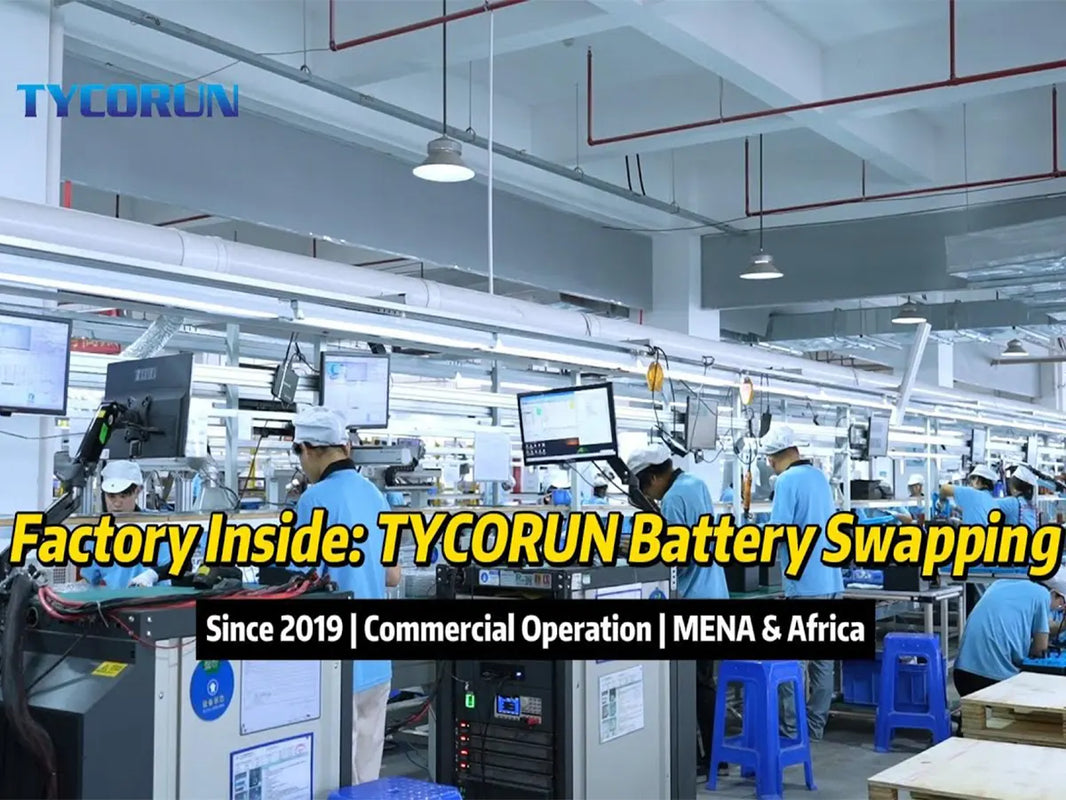
TYCORUN is an international battery swap solution provider founded in 2019, specializing in smart battery swapping infrastructure, standardized batteries, intelligent cabinets, and integrated cloud-based battery management platforms. Deployed across 48+ countries, TYCORUN's technology supports urban mobility, delivery fleets, last-mile logistics, and EV service operations worldwide.
What TYCORUN Offers
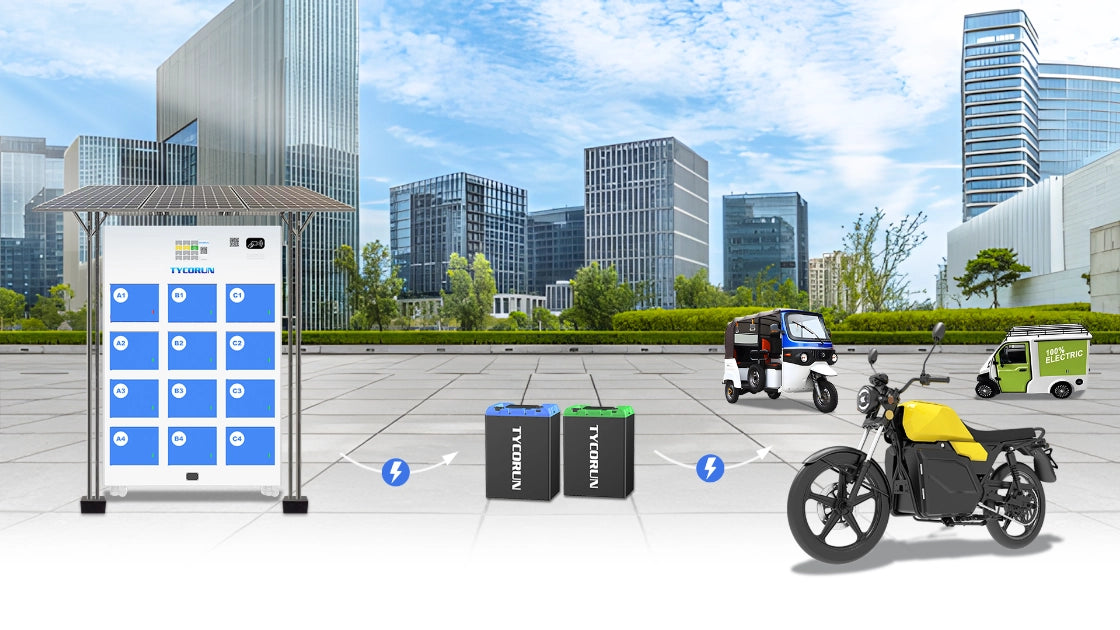
- Swappable Batteries: Standardized lithium and semi-solid batteries designed for quick interchange and stable performance across commercial use cases.
- Intelligent Swap Cabinets: Multi-slot cabinets with smart charging control, multi-protocol support, real-time monitoring, and integrated safety features.
- Cloud-Based Swap Platform: Backend system enabling real-time battery tracking, station management, and fleet performance analytics.
- Software & Mobile App: User and operator interfaces for station location, battery status, swap reservation, and payment.
- Turnkey Deployment Support: ROI planning tools, local team training, and system setup for operators deploying swapping infrastructure.
Key Operational Specifications
- Swap time: 60–120 seconds depending on configuration
- Cabinet configurations: 5, 8, or 15-slot options supporting simultaneous swaps at high-throughput locations
- Monitoring: Real-time battery condition tracking, thermal alerts, and cloud analytics
- Customization: Adaptable to specific battery chemistries, voltage ranges, and station deployment scales
- Commercial models: Battery leasing, pay-per-swap, and combined structures to reduce upfront investment
FAQ
What is battery swapping for EVs?
Battery swapping is a method of replenishing an electric vehicle's energy by physically removing the depleted battery and replacing it with a pre-charged one at a dedicated swap station. The process typically takes 60–120 seconds, compared to 30 minutes for a fast charger or 4–8 hours for a home charger — eliminating charging wait time entirely for commercial fleet operations.
Which is the largest battery swapping network in India in 2026?
As of 2026, Battery Smart operates the largest battery swapping network in India for two- and three-wheelers, with over 1,569 active swap stations, 281,000+ circulating batteries, and 100 million historical swaps. SUN Mobility follows with 600+ Quick Interchange Stations, and Yuma Energy has reached 2,000+ stations across 17 cities with 50 million completed swaps.
What is Battery-as-a-Service (BaaS)?
Battery-as-a-Service (BaaS) is a commercial model where the battery is not included in the electric vehicle purchase price. Instead, the fleet operator or driver pays a subscription or per-swap fee to access charged batteries at swap stations. For B2B operators, BaaS reduces upfront fleet acquisition costs, transfers battery maintenance and degradation risk to the service provider, and converts energy expenditure from a capital cost to a predictable operating cost.
Is battery swapping safe for commercial fleet operations?
Yes. Battery swapping systems deployed by leading Indian operators meet established safety standards. Swap stations include thermal management systems, real-time battery condition monitoring, and safety interlock mechanisms. Standardized battery packs are quality-checked before each swap cycle, and IoT-connected platforms flag degraded batteries before they re-enter circulation.
Which vehicles support battery swapping in India?
Battery swapping in India currently serves electric two-wheelers (scooters and motorcycles) and electric three-wheelers (e-rickshaws and auto-rickshaws), which together account for approximately 80% of India's commercial EV fleet. Operators including RACE Energy and Mooving offer retrofit kits for existing non-swappable vehicles, while heavy-duty truck swapping is in early pilot stages at ports including JNPA.
What is the difference between battery swapping and EV charging for fleet operations?
EV charging replenishes the battery while it remains in the vehicle — taking 30 minutes (DC fast charger) to 8 hours (AC home charger). During that time, the vehicle cannot generate revenue. Battery swapping replaces the depleted battery with a pre-charged unit in under 2 minutes, eliminating downtime entirely. For high-utilization delivery fleets, the difference between charging and swapping can mean 2–4 additional delivery hours per vehicle per day — with direct impact on fleet revenue and operating cost per delivery.
Related articles: Battery swapping business model, Battery swapping station cost, Top 10 electric scooters with swappable batteries in the world